Origin · Our story
Same Starting Line, Different Paths
We started in the same market SBF did, at the same time, with the same playbook. He's in prison; we're one of his creditors. Our side of the story.

Origin · Our story
We started in the same market SBF did, at the same time, with the same playbook. He's in prison; we're one of his creditors. Our side of the story.
In brief
For years, SBF’s FTX work anniversary surfaced in our LinkedIn feed every spring. The platform didn’t know what had happened; it only knew a profile hadn’t been updated. So the card went out, and the comments filled with congratulations — a joke the internet kept telling long after the collapse and the sentencing. In spring 2026, the card didn’t come. FTX had lasted three years; its founder was serving a 25-year federal sentence.
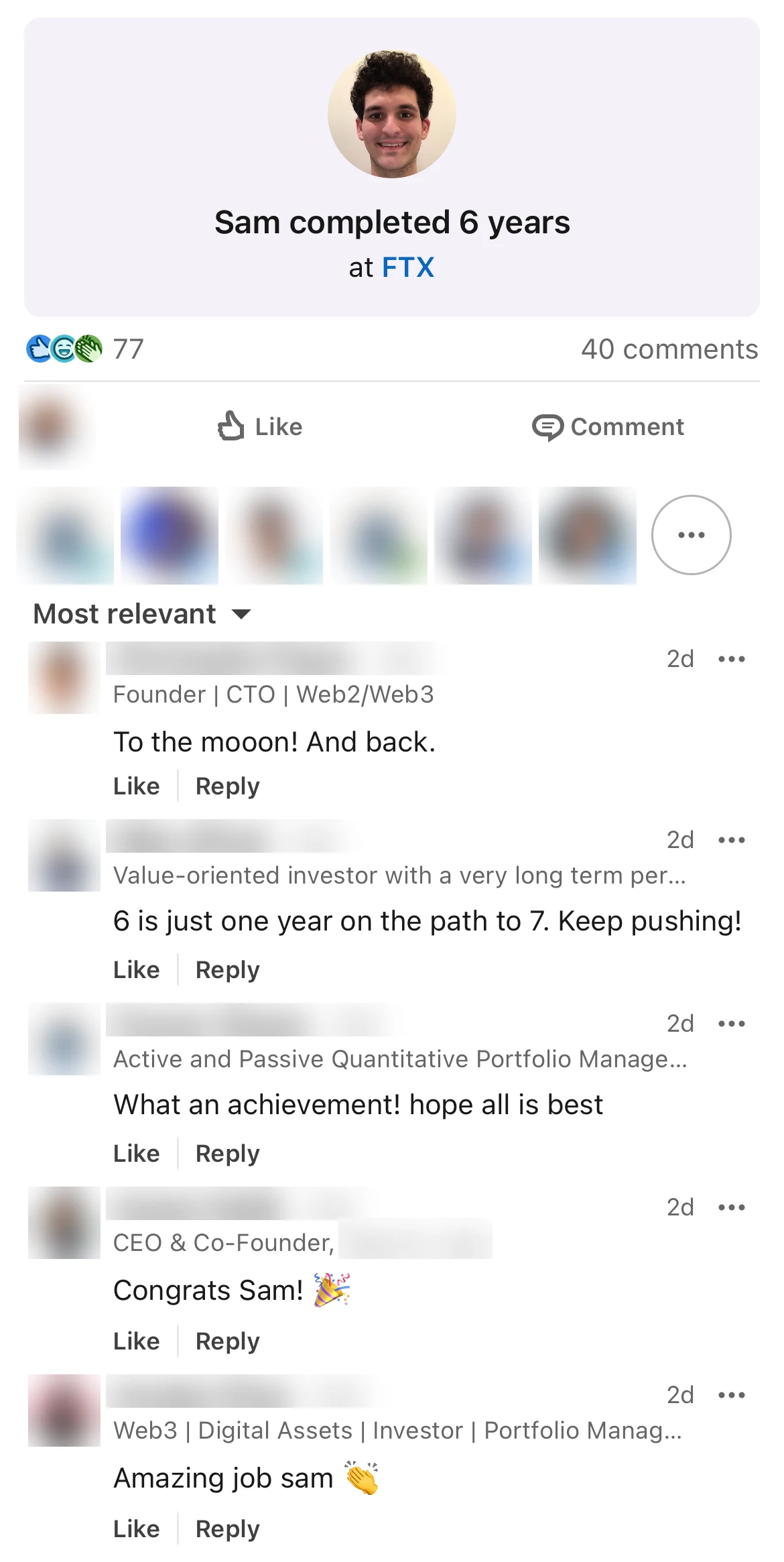
We laughed the first time, like everyone. It got harder each year — not because we knew him well (we didn’t), but because we knew him a little, and because of what the anniversary marks for us. He showed up in our DMs years before he showed up in courtrooms. And the people SBF owed money to are finally getting paid.
We’re one of them.
This is our side of that story. We started in the same market, in the same year, running the same trade; they became the whale, and we stayed small and traded on it. It is not a story about being smarter. It is about what a small firm learns when the fastest-growing counterparty in its market collapses — and why the decisions that look overly cautious on quiet days are the ones that decide whether you’re still around afterward.
In late 2017, Sam Bankman-Fried left Jane Street, where he’d traded ETFs, and founded Alameda Research. Gary Wang, an MIT classmate who had been building flight-pricing systems at Google, joined him soon after. Two people, elite training, early to a market almost nobody serious was in yet, and focused on one thing.
We also started as two people. Our founder recruited a childhood friend — not for the friendship, but for the credentials: the best student he had known at school, by then building risk-management systems at a top brokerage in China. We were early too. But we were not focused. We wandered, chasing whatever the market was excited about that month, and paid tuition in expensive lessons. The one unambiguously right call in those years was to buy some bitcoin and ether and never sell.
What worked as a business was cross-border arbitrage. The idea was simple: the same bitcoin traded at different prices in different countries, because money couldn’t move between exchanges as fast as prices did. The hard part was never the idea. It was the plumbing — moving fiat across borders, through banks that didn’t want the business, fast enough to catch a spread that could close any day.
Alameda’s version was the famous one: Bitcoin at a premium on Japanese exchanges, reportedly $25 million a day at its peak. Ours ran through different exchanges and corridors at a fraction of the size, but it was the same trade. For those months we were playing the exact same game.
They played it far better. Alameda raised capital against the trade and scaled it. We were bootstrapped, with neither the fundraising skill nor the relationships to keep pace, and by the time we were ready to put real size behind it the window had closed — China shut down its exchanges, and the remaining spreads closed as the plumbing caught up everywhere. The difference in those early years had nothing to do with honesty. They were better, and faster to raise. All of it was clean: legitimate, brilliant, and brief.
It also cost us our bank. A US bank in 2018 looked at a small company regularly wiring money to Coinbase or Kraken and saw exactly one thing. JPMorgan Chase closed our accounts — business and personal, along with six credit cards — with no explanation that meant anything. It was crypto-era debanking, and it didn’t care how careful your books were.
When the window shut, both firms faced the same question: what now? They answered it in months. We took years.
Alameda’s answer was to become a proper quant firm — high-frequency trading and market making across most major exchanges, strategies from simple mean reversion to heavier machine learning. Then, in 2019, they built the exchange they wished they’d been trading on: FTX.
Ours was messier, because we flinched. The China ban, the bank closure and the first real crash landed in the same stretch, and the winter that followed made trading feel less like a business than a liability. We were, honestly, scared of trading crypto again. So we looked for an easier way forward, even considered leaving the sector, and tried a run of ideas at its edges — a better exchange, a DEX swap product, lending against crypto collateral. Each was either too early or not different enough; others built some of them a little later and did very well. Being early and being wrong can feel like the same thing from the inside, and for a while they were.
Then COVID hit. The events and travel stopped, and with them the stream of shiny things to chase. In the quiet we asked the question we’d been avoiding — what do we actually want to be? — and the answer was the thing we’d been best at all along: high-frequency trading, on a system we would build ourselves. The goal would have gotten us laughed out of most rooms in crypto: while the industry chased high returns on leverage, we were aiming for a steady 20–25% a year, consistency over fireworks.
A system and a strategy turned out to be the easy half. We still needed a bank. The answer was Silvergate — one of the two banks that would take crypto businesses when the others wouldn’t, with a settlement network built for exactly our kind of volume. Practically everyone in the industry dealing in real size banked there. FTX would, too. Hold that thought.
Banking was only the first door. A desk also needs counterparties willing to face it — liquidity providers, credit, the institutional relationships that turn a strategy into a business — and those doors were guarded too. One of the more selective OTC liquidity providers declined us outright as too small to be worth onboarding. Too small for the institutions, too crypto for the banks: that was the gap every small desk lived in.
If you’ve seen The Big Short, you know Brownfield Fund: two people running their own money, too small for the bank to give them an ISDA, yet able to see an opportunity the large desks had ignored (the lobby scene captures the feeling). That was our position, with one inversion. Brownfield lost small and won enormously once; arbitrage and market making win small most days and can lose big on the rare bad one. There is no jackpot. The profit has to come from volume, consistency, and surviving. In our business, the risk management is the strategy.
Here’s the part nobody expects: one of the desks that did say yes was Alameda. Somewhere in those years, Sam found us.
Long before FTX was a Super Bowl ad, he was doing outbound sales on LinkedIn — personally, the way a good founder does: direct, specific, useful. Alameda’s offering to a shop like ours was almost boringly brilliant: an OTC fiat–stablecoin on-ramp. Zero fees were typical among institutional OTC desks (B2C2, Cumberland, Genesis) — the money is in the spread — but Alameda’s spread was tighter than any of them would quote a desk our size. It was exactly the product we needed, sold to us by the person who would later owe us money.
That’s the version of Sam we knew: a distant acquaintance who was very good at trading, and at finding customers. The same instinct that found a hundred small desks like ours later found venture capital, then celebrities, then Congress. Trading and selling were never the parts he got wrong.
FTX grew through COVID into one of the largest venues in crypto, second only to Binance by volume, and the speed ran through the whole company. Other OTC desks settled by hand, once or twice a day; Alameda’s OTC desk, later folded under FTX, settled around the clock, usually inside an hour or two. Report an API bug elsewhere and a support rep filed a feature request into the void; at FTX we had a Telegram line to the engineer who owned the code, who would diagnose it live down to the database schema, ship the fix, and ask us to test. It happened so fast we joked about whether their CI/CD was that good, or whether they had one at all.
One incident stuck with us. They once sent us roughly a million dollars of ETH by mistake — a transfer that should never have cleared. We returned it, and came away with mixed feelings about a company that could ship a fix in an hour and also misplace a million dollars. In hindsight it was the whole collapse in miniature: an exchange moving large sums with nothing in the loop to verify them, and nothing that flagged the error before the counterparty did.
Our own curve was smaller and bumpier, but we found our focus — market making and arbitrage, systematized — and the numbers became real: about $1 billion a year in traded volume on roughly $1 million of deployed capital. A small number in this industry, and a large one for a team that had been afraid to trade three years earlier. For the first time, our curve looked like a business.
By 2021, if the crypto ecosystem was an ocean, FTX was the whale at the top of the food chain and we were a small fish. Our billion dollars a year was a rounding error against FTX’s daily volume: they had raised billions and hired hundreds; we were a handful renting compute.
The difference that mattered isn’t the obvious one about greed. Other people’s money doesn’t just add size; it changes who enforces the limits. When every dollar at risk is your own, a risk limit enforces itself — you feel the breach. When the dollars are customers’, the limit is a policy, and policies get overridden by whoever is in a hurry. SBF raised money — from investors, then, as a jury later established, from customer deposits — and that is what built the whale. We had only our own, so our limits were never up for debate. It kept us small. It also, as it turned out, kept us.
We traded on FTX for the liquidity and the execution quality. Not using it would have meant leaving money on the table every day to hedge a risk that looked theoretical.
Until it wasn’t.
One more Big Short scene explains why the collapse was never really a November event: the Jenga tower, where mortgage tranches are stacked risky-at-the-bottom, AAA on top, and fall together because they are the same mortgages graded differently. FTX’s tower had a stranger flaw. Alameda was borrowing heavily — including, as the trial later laid out, against customer funds routed to it through the exchange — and the collateral was largely FTT, a token FTX had issued itself, thinly traded, whose price Alameda’s own buying helped hold up. In the mortgage tower the bottom blocks were merely correlated. In FTX’s tower they were made of the tower: the collateral’s value depended on the borrower’s sibling staying solvent, and vice versa. That structure was in place through the entire peak. The crisis wasn’t triggered in November 2022. It was built in, and November was just when someone pulled the block.
A leaked Alameda balance sheet on November 2, showing how much of it was FTT. Binance’s CEO, CZ — one of the largest FTT holders outside FTX — announcing on the 6th that he would sell. FTT falling, the collateral falling with it, and roughly six billion dollars of withdrawal requests hitting FTX in seventy-two hours. A rescue by Binance announced on the 8th and abandoned on the 9th, after a look at the books. Withdrawals frozen. Bankruptcy on the 11th, and the number hiding inside the tower made public: an eight-billion-dollar hole where customer deposits should have been, routed to Alameda through what the trial would later describe as a backdoor in the exchange’s own code.
We were trading on FTX through all six days. Our risk systems flagged the trouble before the public narrative caught up — not because they understood balance sheets, but because the market’s plumbing started screaming: extreme volume and volatility, and a spread opening between FTX’s OTC prices and the rest of the market. When one venue’s prices detach from everywhere else’s, either the market is wrong or the venue is. We didn’t need to know which. We triggered our withdrawal protocols and got the large majority of our funds out before FTX froze withdrawals.
That is the operating lesson, and it is smaller than it sounds. Our systems never read a balance sheet. They watched one venue’s prices detach from the world and executed a decision we had made years earlier, on a quiet day, about what to do when that happens. Most of the firms stuck on FTX saw the same prices we did. What they lacked wasn’t information; it was a decision made in advance.
A five-figure amount didn’t make it. The FTX interface showed the withdrawal as “processed,” but the transfer never landed — those funds never left FTX, and they joined our bankruptcy claim.
Marine biologists call it a whale fall: when the ocean’s largest animal dies and sinks, an entire ecosystem feeds on the carcass. That’s what the weeks after FTX looked like — arbitrage desks feasting on dislocations, FTT shorts collecting, distressed-claim buyers circling, everyone eating fast. But a whale fall has rules. Eat quickly and swim away, and it’s the meal of the year. Eat greedily — stay too long, go too deep inside — and you get trapped in the carcass and sink with it. We were a little greedy ourselves: the five figures we left in were the price of the last few meals. But we swam clear.

Plenty of firms were still inside the carcass — funds they couldn’t withdraw — and some sank with it: BlockFi in bankruptcy within the month, Genesis frozen in two weeks and gone by January, Galois Capital wound down with half its assets stuck on the exchange.
The damage didn’t stay in the water. Silvergate — the bank that had taken us in when Chase wouldn’t, and that banked most of the industry including FTX and Alameda — faced a run of its own as crypto depositors pulled most of its deposits in a single quarter. To meet the withdrawals it sold long-dated securities at deep discounts, realizing over seven hundred million dollars of losses in one quarter — roughly a decade of profits, erased, at a small community bank almost nobody had heard of before it became the most influential bank in the industry. In March 2023, Silvergate chose a voluntary wind-down — and returned every dollar of ours.
We had already started moving to Signature Bank, the industry’s other pillar, as Silvergate wobbled. A couple of weeks of paperwork, the account went live, the API integration was done — and that weekend regulators took over the bank, two days after Silicon Valley Bank’s collapse started a run on every bank that looked like it. Signature’s crypto business was shut down. Every dollar of ours came back again.
Three banks in five days — Silvergate, Silicon Valley Bank, Signature — two of them ours, and both times the money came home. Counterparty quality reads backwards. The banks that were hostile, slow and bureaucratic returned every dollar. The counterparty that had been fastest, cheapest and most eager for our business is the one that didn’t. Terms better than anyone else can quote are being financed by something, and you usually can’t see what.
Then the domino reached us — not our balance sheet, which had held, but everything around it. No bank would take a crypto trading business; the rails between dollars and stablecoins were dead or frozen; confidence had left the market, and volume with it. We suspended all trading. There is no responsible way to run a live book with no banking, no fiat rail, and a counterparty failing every week.
Then the team left. Not in anger — in conviction. From inside that winter, the reasonable read was that crypto was over and the smart move was to take what you’d learned somewhere safer. Confidence doesn’t shatter all at once, but over the months that followed the firm shrank to one person, a suspended trading system, a bankruptcy claim, and a decision to make.
That is where the whale fall left us — not in the carcass, but alone on an empty stretch of ocean, with everything we’d built still intact and nothing around it left standing.
The decision didn’t come easily. It was the second time we seriously considered leaving, and we had every reason the departing team had, plus a suspended system and a bankruptcy claim to look at every morning. We chose to rebuild anyway, and we’d be lying if we called it obvious at the time.
The system that has now run live for years — the one the rest of this series is about — was rebuilt by one person, from the low point of the industry, on the same discipline that had just carried nearly every dollar of our own money through two bank failures and the largest exchange collapse in crypto’s history. The team was rebuilt the same way — smaller, slower to hire, and selected for the one property the system had: the ability to hold through a winter. It was slow and unglamorous, but it worked.
The claim was the slow part. We joined the queue with thousands of other creditors, in proceedings run by John Ray III — the restructuring specialist who unwound Enron, and who called FTX’s books the worst he had ever seen. The outcome was better than almost anyone predicted the week of the collapse: the estate paid allowed claims back in full, with interest. Ours came to about 20% on top of principal — roughly 120 cents on the dollar, a little over two years late. The bankrupt exchange paid better than a savings account.
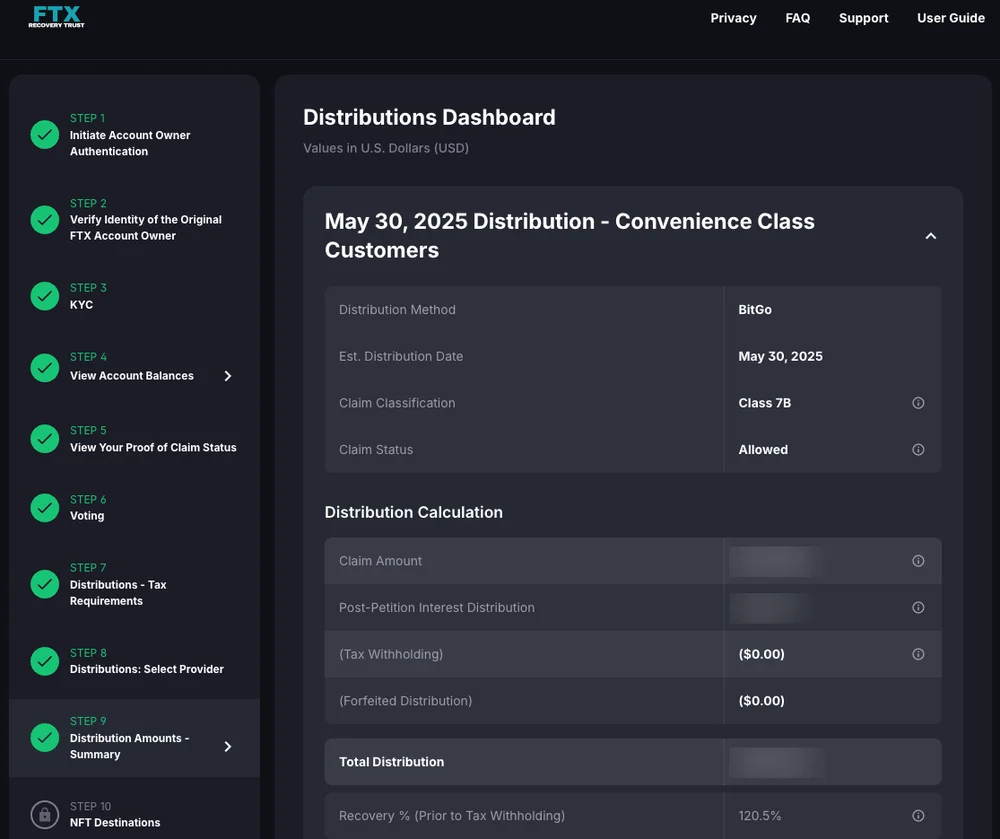
Not every creditor was this fortunate — claims were fixed in dollars at November 2022 prices, a real loss for anyone who had held crypto there. But the week FTX fell, the consensus was that every dollar was gone. The consensus was wrong, slowly and boringly, in a Delaware courtroom.
Here is the strangest part, the part that turns a fraud tale into a tragedy: he didn’t need to do it.
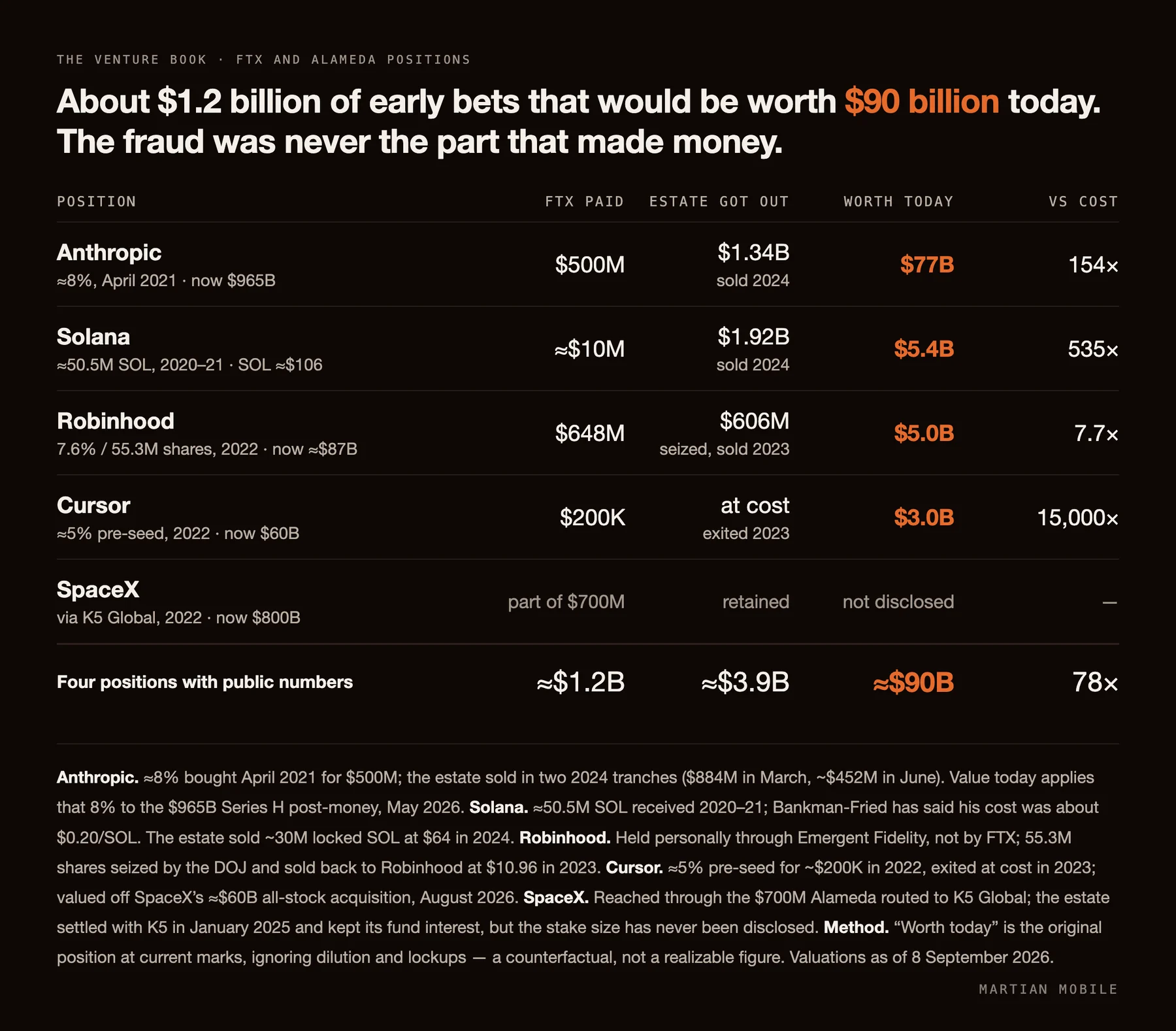
Strip out the crime and look at what remains. A genuinely dominant exchange printing revenue. A trading firm with real, if declining, edges. A venture book bought with early conviction — Solana at pennies, an early stake in Anthropic, SpaceX and Cursor — collectively worth many billions today. Had customer funds stayed where they belonged and the growth been financed from legitimate sources, FTX would likely still be one of the world’s leading exchanges, and SBF would be remembered as one of the great investors of his generation instead of serving 25 years.
After the collapse, and again at trial, his explanation leaned on a peculiar claim: the dashboards hadn’t shown accurate numbers. The number he meant, by his own account and later testimony, was Alameda’s liability to FTX’s customers — roughly eight billion dollars of customer deposits that had landed in Alameda-controlled bank accounts, tracked under an internal account labeled fiat@ftx.com and left out of the risk view. As if the problem were a UI bug. A jury needed about four hours to reject that.
This was not a firm that forgot to reconcile. Testimony described a special exception in the exchange’s code that let Alameda’s account go negative without limit, and the mislabeled account is what kept the eight billion out of view. A real reconciliation — the routine check that what your ledger says you hold is what the world says you hold, run independently of whoever moves the money — would have made the mismatch impossible to ignore. There wasn’t one, because, as the jury found, the people running the books were the people moving the money, and they were allowed to write themselves the exception. We had seen the small version ourselves: a million dollars of ETH arriving by mistake, and nothing on their side that noticed. A dominant exchange, a real trading firm, a venture book worth billions — and underneath all of it, a control that someone was allowed to switch off. A business can be successful and structurally unsound at the same time. The moment a control is optional, everything above it is theater.
SBF didn’t fail because crypto is a scam, and we didn’t survive because we were smarter. The early years settle that: he out-traded us, out-built us, out-sold us. What eight years actually taught us is less flattering and more useful.
The advantage and the failure were the same property. Raising fast is what beat us in 2018, and other people’s money is what built the whale. It is also what made the limits negotiable. There was no version of him with the speed and without the exposure; the trait doesn’t split. When you envy a competitor’s edge, ask what it is a loan against.
Survival is decided on the quiet days. The independent reconciliation that could have exposed FTX on day one is boring, and boring is why it is the first control people opt out of. The withdrawal decision that got our money out was made on a day when nothing was happening. Every dollar being our own didn’t make us disciplined. It made the discipline non-negotiable, and the non-negotiable part is what holds. Structure, not virtue.
Because chaos does come. In eight years, exchanges collapsed, banks failed, regulations flipped overnight, protocols were exploited. The firms still here aren’t the ones that avoided the chaos. They’re the ones built to withstand it.
The market we started in no longer exists, and not because of FTX. When we began, “quant” came with a floor of engineers and PhDs as the price of entry. Chatbots broke the information ceiling and AI agents broke the build barrier: a determined solo operator can now prompt their way to a system that trades. That doesn’t mean anyone with a Claude subscription can replicate Two Sigma next month. It makes the field crowded — thousands of look-alike strategies trading against each other with identical tools — and it moves the edge out of any single strategy and into the machine around them: the one that originates, validates against real fills, kills on evidence, and replaces faster than the copies converge. That’s where we’re heading, and a story for another post.
That’s our book, though, and it would be a narrow place to end. Trading is the least important thing happening in this industry. Speculation is zero-sum — every dollar we made arbitraging came from someone on the other side — and bitcoin has no value anchor beyond what the next person will pay. That is also true of gold, and of the dollar, so it is not an argument that bitcoin is worthless. It is an argument that bitcoin cannot be valued, only priced: no cash flow, no redemption, nothing to discount. Knowing that is our job. Underneath the speculation, things got built that are hard to unsee: stablecoins settle dollar volume on the order of the major card networks; the fiat rails we spent 2018 begging banks for now exist; regulation is in place; on-chain venues turned “trust the exchange” into “read the code” — the commingling that took down FTX would be visible to anyone, in real time. Debanking is a harder thing to do to a wallet. None of that needed SBF, and none of it died with him.
We don’t know which of those threads matters most in five years, and we’re suspicious of anyone who says they do. What we do know is that AI is doing to this industry what fragmented markets did in 2017: handing everyone the same starting line at once. The tools that took us eight years to build are becoming an afternoon’s work; the discipline to run them through a winter is not. Nobody has yet shown what a trading firm looks like when the strategies, the engineering and the risk are all written and rewritten by machines. The rails are laid. The rules of the next race are not.
So if you’re building here, in trading or anything else, the starting line is open again. Which path are you taking — and what would it take to make you choose the slow one?
If you’re building, allocating, or validating a strategy and want to compare notes, start a conversation.
Martian Mobile is a proprietary crypto trading firm operating since 2018. More from the series on survivability, trading operations, and validating edges: Insights.